

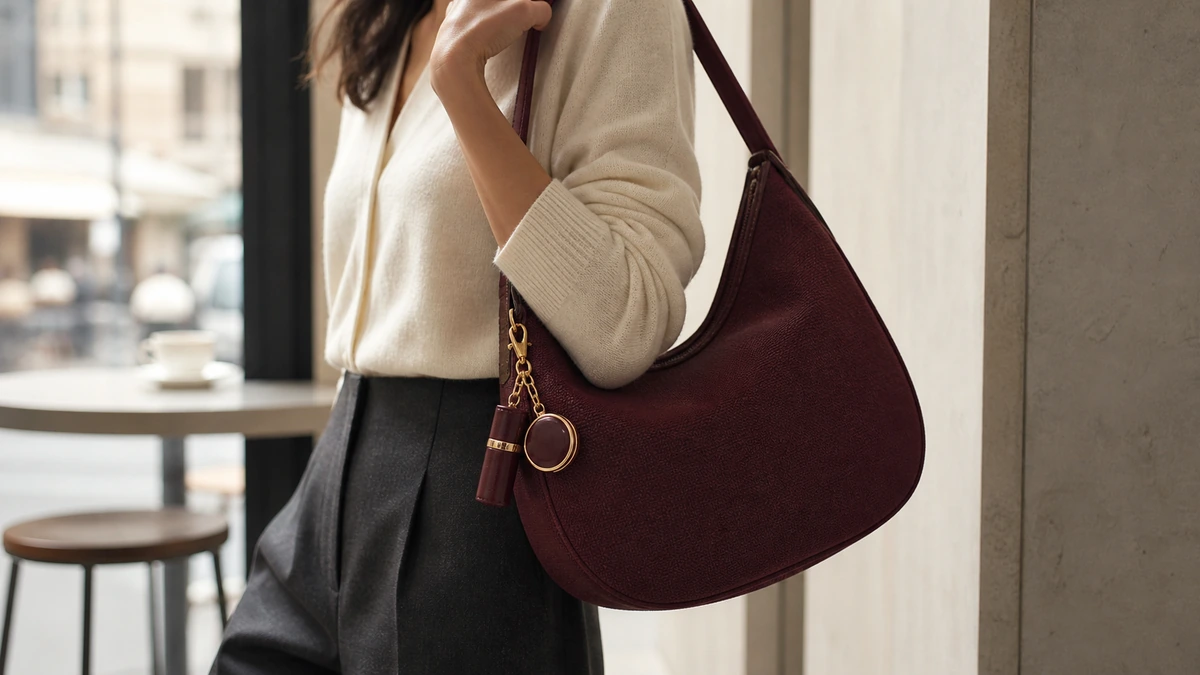
Your handbag used to carry your lip balm. Now the lip balm wants a seat by the window.
That is the playful logic behind beauty bag charms with a practical side: mini cases, mirrors, holders and tiny pouches that hang outside a bag while doing a real job. They are still decorative, but decoration is no longer the whole assignment.
This does not prove that every shopper wants a cosmetic dangling from a handle. It does show that several independent fashion and beauty editors are discussing a more useful branch of the bag-charm idea in 2026—and that gives consumers, designers and buyers something more interesting to examine than another round of cute key rings.
What Makes a Bag Charm “Functional”?
A decorative charm only needs to look appealing and stay attached. A functional charm also has to carry, protect, reveal or organize something: a mirror, a solid fragrance, a small grooming tool, a lip product or another compact essential.
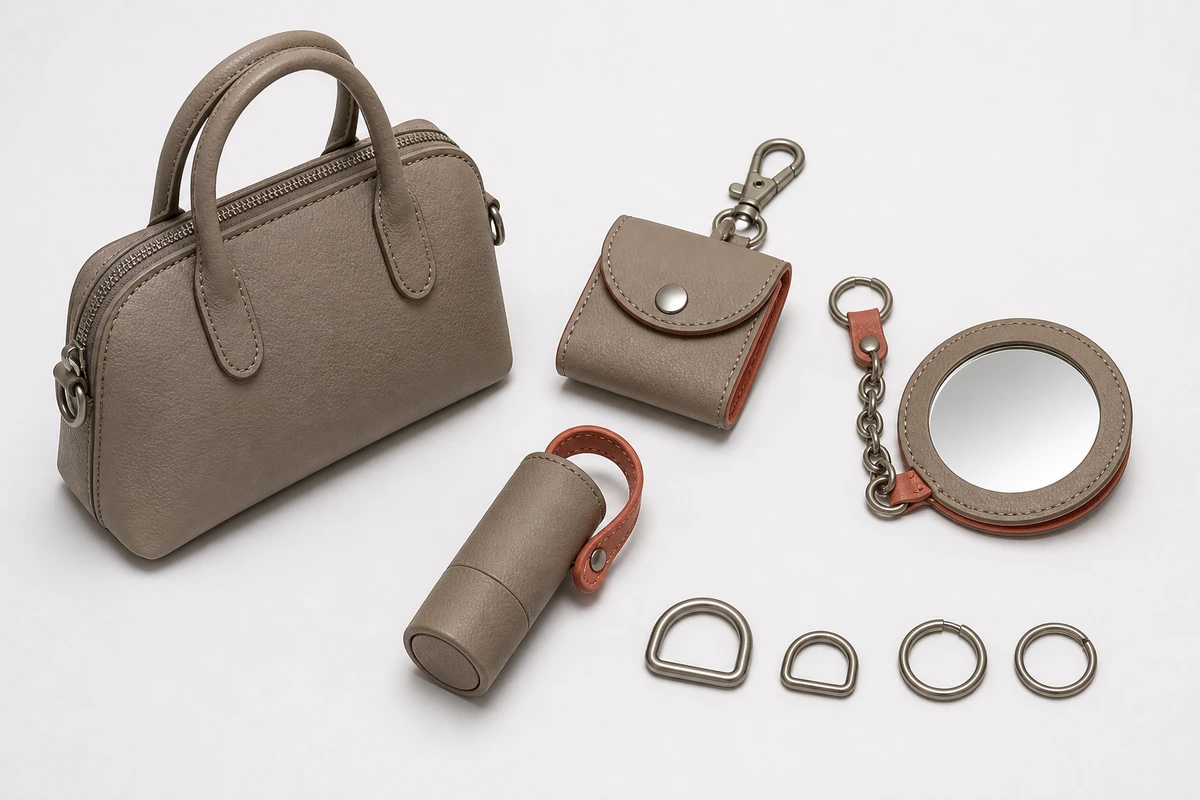
The category can include several formats:
- a fitted holder made for one replaceable item;
- a zipped micro pouch that accepts different small objects;
- a protective case with a mirror or tool built into it;
- a detachable mini container that moves between bags.
The distinction matters because use creates requirements. A charm that opens several times a day needs a reliable closure; a cosmetic holder needs a secure fit; a mirror needs edge protection; and any container must be easy to clean if a product leaks.
For a shopper, the reward is quick access and a little personality. For a product team, the “little” accessory is already becoming a system of material, hardware, fit and safety decisions.
Why the Idea Is Getting Attention in 2026
The evidence is editorial rather than statistical. Vogue Italia reported on beauty bag charms seen around Copenhagen street style in August 2026, describing formats such as miniature brush, perfume, mirror and lipstick holders.
ELLE covered the category in April, while Who What Wear returned to it in July. Together, these independent publications support a careful claim: functional beauty charms have remained visible in 2026 fashion and beauty coverage.
They do not establish search volume, sales growth or universal consumer demand. There is also a counter-signal: British Vogue argued earlier in the year that some wearers were tiring of charm-heavy styling and looking at other ways to personalize bags.
That tension may be exactly why function matters. A useful attachment has a reason to remain after novelty fades, although its long-term appeal will still depend on design, durability and how naturally it fits daily life.
This topic is also distinct from XAOBAG’s earlier look at larger, softer and flatter Fall 2026 bags. That article focused on the architecture of the main bag; this one asks what happens when a detachable object becomes part of that architecture.
From Decoration to Product Architecture
From a product-development perspective, the first question is not “How cute is it?” It is “What forces travel through the attachment point?”
A filled charm adds weight and movement. When the wearer walks, the object can swing, twist and knock against the bag, so the load is not purely static. Designers may want to consider whether the charm connects to a handle base, a dedicated D-ring, a zipper pull or another point designed to accept repeated movement.
The attachment method changes the experience. A snap hook is quick to move but needs sufficient gate clearance; a split ring can feel secure but may be awkward for frequent changes; a short chain adds movement but can tangle; and a narrow loop may wear against a coated edge.
Scale matters too. An oversized charm can pull a small shoulder bag off balance, while a tiny holder may look lost on a large tote. The ratio should be judged with the charm filled, not only as an empty prototype photographed on a table.
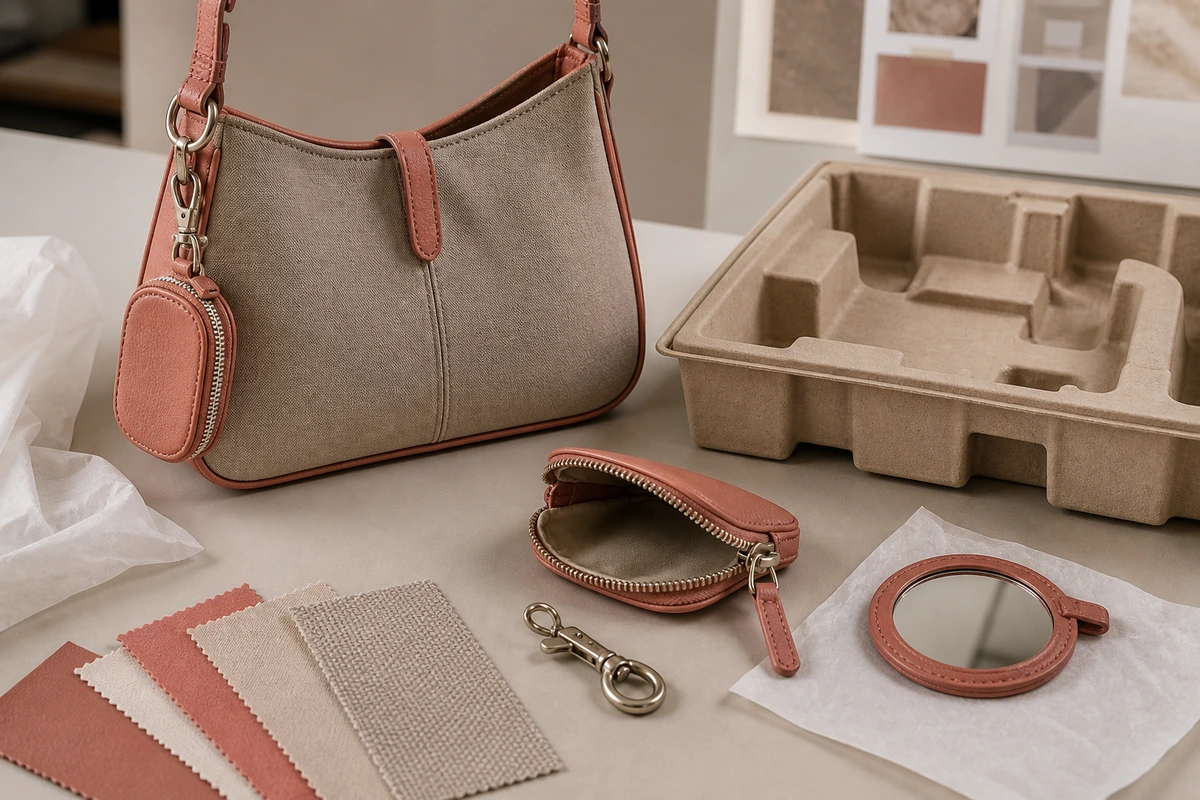
Material and color coordination go beyond matching a swatch. A coated fabric, textile, metal finish and cosmetic component can react differently to abrasion, moisture and light. This suggests testing the combination as a set, especially where hard edges or colored surfaces repeatedly touch the main bag.
For broader examples of bag constructions and silhouettes, XAOBAG’s product overview provides useful context. It should not be read as a claim that every shown style is already engineered for a functional charm.
What Designers and Buyers Should Check
A functional charm deserves its own line in the development brief. “Add a mini pouch” is not enough information for sampling, costing or quality review.
Use this practical checklist before approving a concept:
- Purpose and fit: Define the object, its maximum dimensions and whether refills or alternate items must fit.
- Attachment and load: Specify the connection point, filled weight and expected direction of pull or swing.
- Detachability: Decide whether removal should be one-handed, tool-free, theft-resistant or deliberately difficult.
- Hardware and edges: Review gate openings, pinch points, burrs, corners and surfaces that may scratch the bag or the user.
- Material and color: Check rubbing contact, color transfer risk, finish compatibility and visual coordination with the main bag.
- Use and care: Consider leaks, cleaning access, replaceable parts and what happens when the charm is used without the bag.
- Packaging and transit: Restrain moving hardware, protect finished surfaces and confirm that the packed charm cannot dent or mark the main body.
From a buyer’s perspective, the approved sample should include the intended contents or a weight-and-size substitute. An empty holder may pass a visual review while failing once the real item is inserted.
Requirements vary by product function and destination market. Brands should verify applicable requirements before production. No single test plan can be assumed for every charm, and a beauty container may introduce considerations outside the normal review of a handbag alone.
Where Functional Charms Can Go Wrong
The most obvious failure is loss: the hook opens, the loop tears or the insert slips out. Less dramatic problems can still ruin the experience, including a charm that rattles loudly, flips upside down, blocks the main zipper or hits the wearer’s hand every time the bag is opened.
Weight can create a chain reaction. A heavier decorative object may strain its own connector, distort a soft bag or accelerate wear where metal and material meet. This is an engineering consideration, not evidence that functional charms are inherently unsafe.
Small components require careful review. Designers may want to consider sharp edges, loose parts and the intended age group, as well as the rules of each sales market. A charm that resembles a toy should not be assumed to be a toy, but appearance and foreseeable use can still affect risk assessment.
Liquids and soft cosmetics add another layer. A cap can loosen, heat can change a formula’s behavior, and residue can transfer to the holder or bag. The safest editorial conclusion is modest: containers and attachments should be evaluated in their intended filled condition, with compatibility confirmed by the responsible product teams.
There is also a style risk. If the attachment looks like an afterthought, it can weaken the main bag rather than personalize it. A dedicated connection point, repeated material detail or coordinated hardware finish can make the accessory feel designed-in instead of clipped-on.
What This Means for Future Bag Collections
Functional charms point toward modularity. One main bag could accept a practical pouch for commuting, a mirror holder for an evening look or a small organizer for travel—provided the attachment system and visual language remain consistent.
This suggests a useful collection strategy: design the bag and accessory together, then decide which elements are permanent, optional or replaceable. A shared connector can create variety without redesigning the entire bag, but it also makes tolerance control and compatibility more important across production runs.
Consumers may appreciate the ability to update a familiar bag without replacing it. Brands may see room for add-ons, gifting or seasonal color, yet none of those outcomes should be assumed before user testing and commercial validation.
Functional bag charms are still small objects. The design questions around them are not small at all—and that may be the most useful reason to pay attention.
Sources
- Beauty bag charms, il nuovo modo cool di portare il beauty sempre con sé — Vogue Italia, published August 19, 2026; accessed August 24, 2026.
- Beauty Bag Charms Are Trending. Here Are the Coolest Ones. — ELLE, published April 28, 2026; accessed August 24, 2026.
- Beauty Bag Charms Are Chicer Than Ever—7 to Add to Basket — Who What Wear, published July 17, 2026; accessed August 24, 2026.
- Move Over Bag Charms, Belts Will Be SS26’s Most Personality Led Accessory — British Vogue, published January 14, 2026; accessed August 24, 2026.